FatigueMonitor
Visualize your fatigue in real-time
Three indicators—cardiovascular, neuromuscular, and stamina—to support your pacing strategy
What is FatigueMonitor?#
We believe monitoring three fatigue indicators is key to optimizing your marathon pace:
- Cardiovascular Fatigue (CV) - Calculated from HR/Speed ratio
- Neuromuscular Fatigue (NM) - Calculated from stride length changes
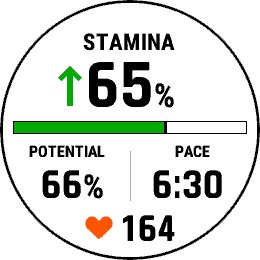
- Stamina - Garmin’s proprietary algorithm estimating remaining energy
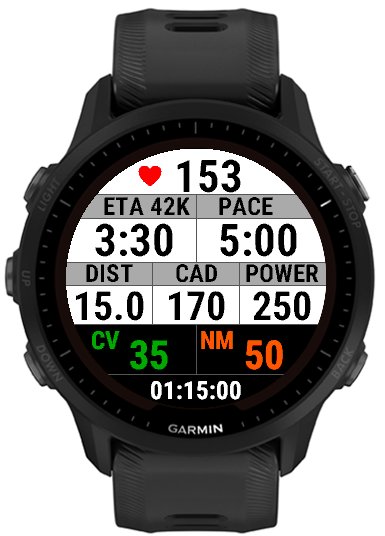
FatigueMonitor is a Garmin Connect IQ data field app that displays CV and NM in real-time. Combined with Garmin’s Stamina display, you can make well-informed pacing decisions from multiple perspectives.
→ How to set up Stamina (Garmin Official)
How to Use#
1. Install#
Download “FatigueMonitor” from the Connect IQ Store.
2. Configure#
Garmin Connect Mobile → Connect IQ Store → My Data Fields → FatigueMonitor → Settings
- Race Distance: Full Marathon / Half Marathon / 10K
- Units: km / miles
3. Add to Data Fields#
Add FatigueMonitor to your running activity’s data fields via your watch or Garmin Connect Mobile, then start your activity.
→ How to add data fields (Garmin Support)
Three Phases#
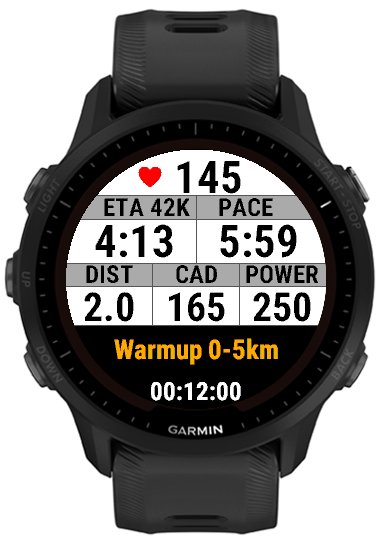
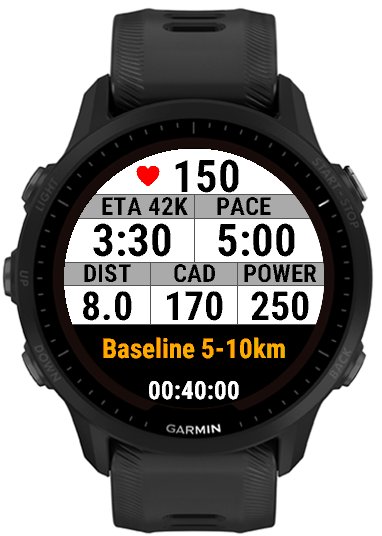
Early race data is often unreliable due to excitement and crowding. Accurate fatigue calculation requires a stable baseline. FatigueMonitor automatically calibrates through three phases.
Warming Up
Data collection skipped
Measuring Baseline
Auto-calibrating baseline
Monitoring Fatigue
Real-time fatigue tracking
※ Phase distances are based on Smyth et al. (2022), analyzing 82,303 marathon finishers
Understanding Fatigue Indicators#
The fatigue indicators displayed by this app are reference values calculated from heart rate, pace, and other data. Actual fatigue is influenced by many factors including physical condition, temperature, course elevation, and sleep. Please verify effectiveness during training before using in races.
🫀 CV (CardioVascular Fatigue)
Calculated from changes in HR/Speed ratio. Detects efficiency loss due to dehydration, glycogen depletion, and rising body temperature.
Detailed calculation →🦵 NM (NeuroMuscular Fatigue)
Calculated from stride length changes. Detects early signs of muscle fatigue and form breakdown. Changes faster than CV, acting as an early warning system.
Detailed calculation →💡 100 = Typical fatigue at marathon finish (CV: 20% decoupling, NM: -10% stride length)
※ CV threshold: Smyth et al. (2022), NM threshold: Lin et al. (2025), Miyazaki et al. (2025), Prigent et al. (2022)
The fatigue indicators displayed by this app are reference values calculated from heart rate, pace, and other data. Actual fatigue is influenced by many factors including physical condition, temperature, course elevation, and sleep. Please verify effectiveness during training before using in races.
Please note:
- Use indicators as a reference for pacing decisions
- If you feel unwell, do not push yourself regardless of the indicators
- Verify the effectiveness of indicators during regular training before racing
- FMP assumes no responsibility for results from using this app
Data Fields#
| Field | Description | Unit | Calculation |
|---|---|---|---|
| ❤️ | Current heart rate | bpm | - |
| ETA | Estimated finish time | mm:ss or h:mm | Under 5km: avg pace, 5km+: last 1km split, Under 1hr: mm:ss, Over 1hr: h:mm |
| PACE | Current pace | /km | 3-second moving average |
| DIST | Distance covered | km | - |
| CAD | Cadence | spm | - |
| POWER | Running power | W | 3-second average |
| CV | CardioVascular fatigue | - | See above |
| NM | NeuroMuscular fatigue | - | See above |
Compatible Devices#
- Forerunner: 935 / 955 / 965 / 970 / 165 / 265
- Fenix: 7 / 7 Pro / 8 Series
- Epix: Gen 2 / Pro Series
- Venu: 2 / 2 Plus / 3 Series
References#
Smyth, B., et al. (2022) Pacing profiles and tactics of 82,303 participants in the London marathon. British Journal of Sports Medicine
Miyazaki, T., et al. (2025) Early marathon running metrics from inertial measurement units predict significant pace reduction. Frontiers in Sports and Active Living
Prigent, G., et al. (2022) Concurrent Evolution of Biomechanical and Physiological Parameters With Running-Induced Acute Fatigue. Frontiers in Physiology
Lin, Y., et al. (2025) Sports Injury Prevention Based on Wearable Sensors. Molecular & Cellular Biomechanics
Chan-Roper, M., et al. (2012) Kinematic changes during a marathon for fast and slow runners. Journal of Sports Science & Medicine